

レイオフのコミュニケーションを分析する: うまくいくこと、いかないこと
つらい時期に会社が従業員に尊厳を持って接するにはどうすればよいか、どんな落とし穴を避けるべきかを理解するために、レイオフのコミュニケーションを分析しました。

Written by
Alexis (Lexi) Croswell,
レイオフの際に会社が従業員に尊厳を持って接するために何ができるのかを理解するために、最近の一対多のレイオフのコミュニケーションを分析しました。選ぶ言葉は、受け取る人に影響します。会社を去る従業員にも、残る従業員にもです。
11月4日、Twitterはスタッフの50%をレイオフしました。この変更は事務的なメールで伝えられ、激しい怒りと訴訟の可能性を招きました。それから1週間もたたないうちに、Metaがスタッフの13%、つまり11,000人のレイオフを発表しました。多くの人がLinkedInで不満を表明し、 支援を申し出て、レイオフの影響を受けた人たちが新しい仕事を見つける手助けをしました。
こうしたニュースが続くなか、私たちのOpen Libraryで「layoffs」という検索語が急増していることに気づきました。Open Libraryでは、レイオフについて伝えるマネージャー向けと、レイオフ後に残った従業員とコミュニケーションを取るマネージャー向けのコミュニケーションガイドを公開しています。このテーマについてどう伝えればよいのか、人々が支えを求めていることが分かります。
レイオフは、従業員体験の中でも難しく、きわめて個人的な部分になりえます。レイオフに関する完璧な従業員コミュニケーションは存在しません。共感を持って伝えるという点で「すべての項目を満たした」としても、人は怒り、悲しみ、動揺し、混乱します。
会社は、完璧を求めるあまり、良いことまで手放すべきではありません。つらい時期に従業員に尊厳を持って接することは可能です。そして、困難な時期に会社が従業員とどうコミュニケーションを取るかは、物事がうまくいっているときのコミュニケーションと同じか、それ以上に強い印象を残します。
最初のレイオフのコミュニケーションを共感から始める
世間で好意的な反応を引き出したコミュニケーション(その多くは社外の人によるLinkedInでのコメントです)のほとんどに、次の6つの要素があることに気づきました。
- 手紙が創業者またはCEO、あるいはその両方から出されている
- 創業者やCEOが責任を引き受け、共感を持って伝えている
- レイオフの経済的な(またはそのほかの)理由が透明性を持って示されている
- 退職金パッケージの詳細が共有されている
- 質問も含めて、直接話し合う時間が設けられている
- 創業者やCEOが、レイオフされる人たちをどれほど大切に思っているかを説明している
これらのコミュニケーションのほとんどに見られず、私たちがお勧めしたいのは、近い将来にもう一度サポートを提供すると明確に伝えることです。数か月後にあらためて連絡するという約束が、最初のコミュニケーションをより効果的にすると私たちは考えています。
その場で提供されても、本人が受け止められなかったり、活用できなかったりするサポートがあります。レイオフされることはショックになりうるからです。人には受け止める時間が必要であり、その時間を与えるべきです。
あなたが提供したサポートのリソースに、1、2か月後に戻ってこられるだけの猶予を設けましょう。理想を言えば、その時期にもう一度あなたから連絡を取り、あらためてサポートを申し出ます。
最近の5つのレイオフのコミュニケーションを分析する
ここ数週間で、Opendoor、Lyft、Stripe、Twitter、そして直近ではMetaが、いずれも従業員をレイオフしました。
以下は、各社の最初のレイオフのコミュニケーションを比較したものです。Twitterを除くすべてのコミュニケーションが、CEOまたは創業者から出され、影響を受ける従業員の割合を明示し、レイオフの経済的な理由と退職金パッケージの詳細を伝えています。
The New York Timesは、10年以上にわたってレイオフを研究してきたハーバード大学の経営学教授、Sandra Sucher氏にインタビューしました。同氏は、Twitterのレイオフは最も対応がまずかった事例の1つだと述べています。
The New York Timesはこう説明しています。「規模は前例のないものではなかったが、誰がなぜレイオフされるのかについて従業員に詳しい説明がないまま、これほど急いでレイオフが行われるのは異例だったと彼女は述べた。『これは、やってはいけない方法のお手本です』とSucher氏は言う。『人を動揺させる方法を順位づけするなら、根拠を示さずに、これからそうすると事前に告げるのは、とりわけ非人道的な扱い方です』」
この比較が示しているのは、人を人として扱うことと、ほとんど配慮せずに扱うこととの歴然とした違いです。責任を引き受けることから、話し合いの時間を設けること、去っていく従業員への感謝を表すことまで、先に挙げた6つの要素を押さえれば、レイオフについて共感を持って伝えることは可能です。
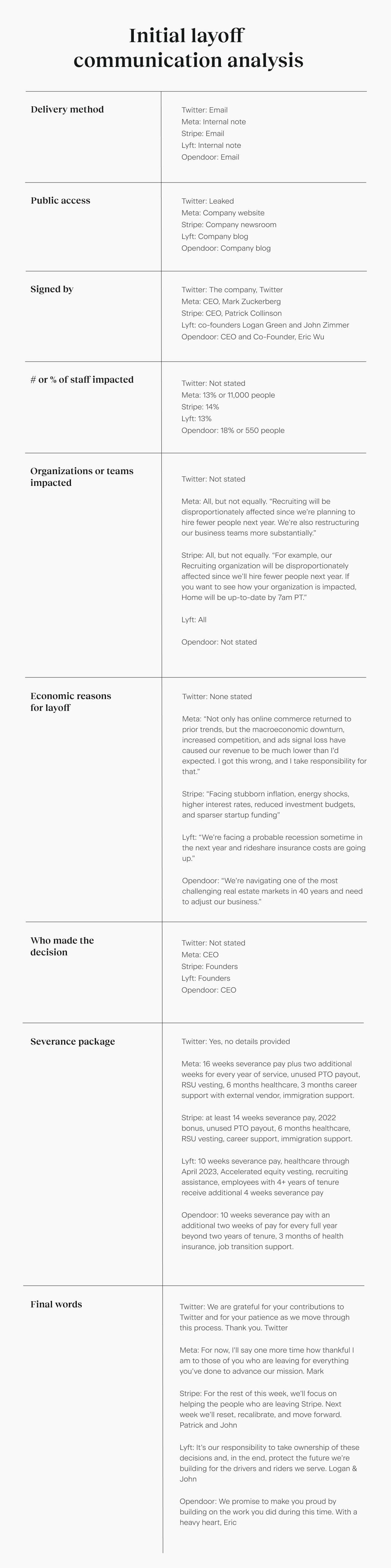
5つのレイオフのコミュニケーションの全文を読む

Meta
Today I’m sharing some of the most difficult changes we’ve made in Meta’s history. I’ve decided to reduce the size of our team by about 13% and let more than 11,000 of our talented employees go. We are also taking a number of additional steps to become a leaner and more efficient company by cutting discretionary spending and extending our hiring freeze through Q1.
I want to take accountability for these decisions and for how we got here. I know this is tough for everyone, and I’m especially sorry to those impacted.
How did we get here?
At the start of Covid, the world rapidly moved online and the surge of e-commerce led to outsized revenue growth. Many people predicted this would be a permanent acceleration that would continue even after the pandemic ended. I did too, so I made the decision to significantly increase our investments. Unfortunately, this did not play out the way I expected. Not only has online commerce returned to prior trends, but the macroeconomic downturn, increased competition, and ads signal loss have caused our revenue to be much lower than I’d expected. I got this wrong, and I take responsibility for that.
In this new environment, we need to become more capital efficient. We’ve shifted more of our resources onto a smaller number of high priority growth areas — like our AI discovery engine, our ads and business platforms, and our long-term vision for the metaverse. We’ve cut costs across our business, including scaling back budgets, reducing perks, and shrinking our real estate footprint. We’re restructuring teams to increase our efficiency. But these measures alone won’t bring our expenses in line with our revenue growth, so I’ve also made the hard decision to let people go.
How will this work?
There is no good way to do a layoff, but we hope to get all the relevant information to you as quickly as possible and then do whatever we can to support you through this.
Everyone will get an email soon letting you know what this layoff means for you. After that, every affected employee will have the opportunity to speak with someone to get their questions answered and join information sessions.
Some of the details in the US include:
Severance. We will pay 16 weeks of base pay plus two additional weeks for every year of service, with no cap.
PTO. We’ll pay for all remaining PTO time.
RSU vesting. Everyone impacted will receive their November 15, 2022 vesting.
Health insurance. We’ll cover the cost of healthcare for people and their families for six months.
Career services. We’ll provide three months of career support with an external vendor, including early access to unpublished job leads.
Immigration support. I know this is especially difficult if you’re here on a visa. There’s a notice period before termination and some visa grace periods, which means everyone will have time to make plans and work through their immigration status. We have dedicated immigration specialists to help guide you based on what you and your family need.
Outside the US, support will be similar, and we’ll follow up soon with separate processes that take into account local employment laws.
We made the decision to remove access to most Meta systems for people leaving today given the amount of access to sensitive information. But we’re keeping email addresses active throughout the day so everyone can say farewell.
While we’re making reductions in every organization across both Family of Apps and Reality Labs, some teams will be affected more than others. Recruiting will be disproportionately affected since we’re planning to hire fewer people next year. We’re also restructuring our business teams more substantially. This is not a reflection of the great work these groups have done, but what we need going forward. The leaders of each group will schedule time to discuss what this means for your team over the next couple of days.
The teammates who will be leaving us are talented and passionate, and have made an important impact on our company and community. Each of you have helped make Meta a success, and I’m grateful for it. I’m sure you’ll go on to do great work at other places.
What other changes are we making?
I view layoffs as a last resort, so we decided to rein in other sources of cost before letting teammates go. Overall, this will add up to a meaningful cultural shift in how we operate. For example, as we shrink our real estate footprint, we’re transitioning to desk sharing for people who already spend most of their time outside the office.We’ll roll out more cost-cutting changes like this in the coming months.
We’re also extending our hiring freeze through Q1 with a small number of exceptions. I’m going to watch our business performance, operational efficiency, and other macroeconomic factors to determine whether and how much we should resume hiring at that point. This will give us the ability to control our cost structure in the event of a continued economic downturn. It will also put us on a path to achieve a more efficient cost structure than we outlined to investors recently.
I’m currently in the middle of a thorough review of our infrastructure spending. As we build our AI infrastructure, we’re focused on becoming even more efficient with our capacity. Our infrastructure will continue to be an important advantage for Meta, and I believe we can achieve this while spending less.
Fundamentally, we’re making all these changes for two reasons: our revenue outlook is lower than we expected at the beginning of this year, and we want to make sure we’re operating efficiently across both Family of Apps and Reality Labs.
How do we move forward?
This is a sad moment, and there’s no way around that. To those who are leaving, I want to thank you again for everything you’ve put into this place. We would not be where we are today without your hard work, and I’m grateful for your contributions.
To those who are staying, I know this is a difficult time for you too. Not only are we saying goodbye to people we’ve worked closely with, but many of you also feel uncertainty about the future. I want you to know that we’re making these decisions to make sure our future is strong.
I believe we are deeply underestimated as a company today. Billions of people use our services to connect, and our communities keep growing.Our core business is among the most profitable ever built with huge potential ahead. And we’re leading in developing the technology to define the future of social connection and the next computing platform. We do historically important work. I’m confident that if we work efficiently, we’ll come out of this downturn stronger and more resilient than ever.
We’ll share more on how we’ll operate as a streamlined organization to achieve our priorities in the weeks ahead. For now, I’ll say one more time how thankful I am to those of you who are leaving for everything you’ve done to advance our mission.
Mark
Stripe
Today we’re announcing the hardest change we have had to make at Stripe to date. We’re reducing the size of our team by around 14% and saying goodbye to many talented Stripes in the process. If you are among those impacted, you will receive a notification email within the next 15 minutes. For those of you leaving: we’re very sorry to be taking this step and John and I are fully responsible for the decisions leading up to it.
We’ll set out more detail later in this email. But first, we want to share some broader context.
The world around us
At the outset of the pandemic in 2020, the world rotated overnight towards e-commerce. We witnessed significantly higher growth rates over the course of 2020 and 2021 compared to what we had seen previously. As an organization, we transitioned into a new operating mode and both our revenue and payment volume have since grown more than 3x.
The world is now shifting again. We are facing stubborn inflation, energy shocks, higher interest rates, reduced investment budgets, and sparser startup funding. (Tech company earnings last week provided lots of examples of changing circumstances.) On Tuesday, a former Treasury Secretary said that the US faces “as complex a set of macroeconomic challenges as at any time in 75 years”, and many parts of the developed world appear to be headed for recession. We think that 2022 represents the beginning of a different economic climate.
Our business is fundamentally well-positioned to weather harsh circumstances. We provide an important foundation to our customers and Stripe is not a discretionary service that customers turn off if budget is squeezed. However, we do need to match the pace of our investments with the realities around us. Doing right by our users and our shareholders (including you) means embracing reality as it is.
Today, that means building differently for leaner times. We have always taken pride in being a capital efficient business and we think this attribute is important to preserve. To adapt ourselves appropriately for the world we’re headed into, we need to reduce our costs.
How we’re handling departures
Around 14% of people at Stripe will be leaving the company. We, the founders, made this decision. We overhired for the world we’re in (more on that below), and it pains us to be unable to deliver the experience that we hoped that those impacted would have at Stripe.
There’s no good way to do a layoff, but we’re going to do our best to treat everyone leaving as respectfully as possible and to do whatever we can to help.
Some of the core details include:
Severance pay. We will pay 14 weeks of severance for all departing employees, and more for those with longer tenure. That is, those departing will be paid until at least February 21st 2023.
Bonus. We will pay our 2022 annual bonus for all departing employees, regardless of their departure date. (It will be prorated for people hired in 2022.)
PTO. We’ll pay for all unused PTO time (including in regions where that’s not legally required).
Healthcare. We’ll pay the cash equivalent of 6 months of existing healthcare premiums or healthcare continuation.
RSU vesting. We’ll accelerate everyone who has already reached their one-year vesting cliff to the February 2023 vesting date (or longer, depending on departure date). For those who haven’t reached their vesting cliffs, we'll waive the cliff.
Career support. We’ll cover career support, and do our best to connect departing employees with other companies. We’re also creating a new tier of extra large Stripe discounts for anyone who decides to start a new business now or in the future.
Immigration support. We know that this situation is particularly tough if you’re a visa holder. We have extensive dedicated support lined up for those of you here on visas (you’ll receive an email setting up a consultation within a few hours), and we’ll be supporting transitions to non-employment visas wherever we can.
Most importantly, while this is definitely not the separation we would have wanted or imagined when we were making hiring decisions, we want everyone that is leaving to know that we care about you as former colleagues and appreciate everything you’ve done for Stripe. In our minds, you are valued alumni. (In service of that, we’re creating alumni.stripe.com email addresses for everyone departing, and we’re going to roll this out to all former employees in the months ahead.)
We are going to set up a live, 1-1 conversation between each departing employee and a Stripe manager over the course of the next day. If you are in an impacted group, look out for a calendar invitation.
For those not affected, there’ll be some bumpiness over the next few days as we navigate a lot of change at once. We ask that you help us do right by Stripe’s users and the departing Stripes.
Our message to other employers is that there are many truly terrific colleagues departing who can and will do great things elsewhere. Talented people come to Stripe because they’re attracted to hard infrastructure problems and complex challenges. Today doesn’t change that, and they would be fantastic additions at almost any other company.
Going forward
In making these changes, you might reasonably wonder whether Stripe’s leadership made some errors of judgment. We’d go further than that. In our view, we made two very consequential mistakes, and we want to highlight them here since they’re important:
We were much too optimistic about the internet economy’s near-term growth in 2022 and 2023 and underestimated both the likelihood and impact of a broader slowdown.
We grew operating costs too quickly. Buoyed by the success we’re seeing in some of our new product areas, we allowed coordination costs to grow and operational inefficiencies to seep in.
We are going to correct these mistakes. So, in addition to the headcount changes described above (which will return us to our February headcount of almost 7,000 people), we are firmly reining in all other sources of cost. The world is hard to predict right now, but we expect that these changes will set us up for robust cash flow generation in the quarters ahead.
We are not applying these headcount changes evenly across the organization. For example, our Recruiting organization will be disproportionately affected since we’ll hire fewer people next year. If you want to see how your organization is impacted, Home will be up-to-date by 7am PT.
We’ll describe what this means for our company strategy soon. Nothing in it is going to radically change, but we’re going to make some important edits that make sense for the world that we’re headed into, and tighten up our prioritization substantially. Expect to hear more on this over the next week.
While the changes today are painful, we feel very good about the prospects for innovative businesses and about Stripe’s position in the internet economy. The data we see is consistent with this encouraging picture: we signed a remarkable 75% more new customers in Q3 2022 than Q3 2021, our competitive win rates are getting even better, our growth rates remain very strong, and on Tuesday we set a new record for total daily transaction volume processed. Our smaller users (many of whom are just “big customers that aren’t yet big”) are, in aggregate, growing extremely quickly, showing that plenty of technology S curves remain in the early innings and that our customers remain impressively resilient in the face of the broader global challenges.
People join Stripe because they want to grow the internet economy and boost entrepreneurship around the world. Times of economic stress make it even more important that we find innovative ways to help our users grow and adapt their businesses. Today is a sad day for everyone as we say goodbye to a number of talented colleagues. But we’re ready for a pitched effort ahead, and we’re putting Stripe on the right footing to face it.
For the rest of this week, we’ll focus on helping the people who are leaving Stripe. Next week we’ll reset, recalibrate, and move forward.
Twitter
Team,
In an effort to place Twitter on a healthy path, we will go through the difficult process of reducing our global workforce on Friday. We recognize that this will impact a number of individuals who have made valuable contributions to Twitter, but this action is unfortunately necessary to ensure the company’s success moving forward.
Given the nature of our distributed workforce and our desire to inform impacted individuals as quickly as possible, communications for this process will take place via email. By 9AM PST on Friday Nov. 4th, everyone will receive an individual email with the subject line: Your Role at Twitter. Please check your email, including your spam folder.
If your employment is not impacted, you will receive a notification via your Twitter email.
If your employment is impacted, you will receive a notification with next steps via your personal email.
If you do not receive an email from twitter-hr@ by 5PM PST on Friday Nov. 4th, please email peoplequestions@twitter.com.
To help ensure the safety of each employee as well as Twitter systems and customer data, our offices will be temporarily closed and all badge access will be suspended. If you are in an office or on your way to an office, please return home.
We acknowledge this is an incredibly challenging experience to go through, whether or not you are impacted. Thank you for continuing to adhere to Twitter policies that prohibit you from discussing confidential company information on social media, with the press or elsewhere.
We are grateful for your contributions to Twitter and for your patience as we move through this process.
Thank you.
Twitter
Opendoor
Team,
I mentioned that the best leaders lead with their head and their heart. It’s with a heavy heart that I share this news today. For those who missed the Open House, we’ve made the difficult decision to reduce our team by ~550 people across all functions – approximately 18% of the company.
The reality is, we’re navigating one of the most challenging real estate markets in 40 years and need to adjust our business. To manage through the turbulence in the market, we’ve worked quickly over the last two quarters to reduce our operating expenses. Prior to today, we scaled back our capacity by over 830 positions – primarily by reducing third party resourcing – and we eliminated millions of fixed expenses. We did not make the decision to downsize the team today lightly but did so to ensure we can accomplish our mission for years to come. And while we may be navigating a once-in-forty year market transition, it doesn’t take away the difficulty, frustration, and sadness downsizing brings. We’ve built a culture and community of #oneteamonedream and worked tirelessly together to serve our customers. This is what makes our decision even more difficult.
When we embarked on this journey nine years ago, almost every investor I spoke with was shocked by the ambition and boldness of our mission – and that instead of an incremental approach, we were willing to do what is best and right for customers to change the entire system end-to-end. Doing something important is going to have its setbacks and ups and downs, but through this journey, we have done just that – we’ve begun the change the system needs. And, even in a moment like today, I can say that your impact has been the catalyst for change and that your work has enabledJulie Damavandi,Robin Race,Julie & Bela, and 200,000 other customers to make life-changing moves.
For those impacted, please know we’re doing everything we can to be fair and generous:
Severance pay:Everyone leaving will receive ten weeks of pay, with an additional two weeks of pay for every full year beyond two years of tenure.
Health care coverage:All current healthcare benefits will remain active for the rest of the month, then we will pay for three months of health insurance.
Job transition support:We will also offer job transition support and launch an opt-in talent directory to help departing team members connect with new opportunities.
We want to provide clarity on next steps as quickly as possible. We’ll be sending an email to everyone at Opendoor within the next hour, which will let you know whether your role has been impacted or not. For those who will be leaving us today, you will also receive a calendar invite to meet with a leader to discuss this change, learn about your separation package, and ask questions.
I understand the burden and responsibility you all have placed on my shoulders, especially to those we are saying ‘goodbye for now’ to. And, that burden weighs heavy as we now have the task to ensure your hard work carries forward and we accomplish our mission. Thank you for showing up every day for our mission, to help our customers, and to change an antiquated industry. I’m grateful that you have helped build and shape Opendoor to where it is today. We promise to make you proud by building on the work you did during this time.
With a heavy heart,
Eric
Lyft
Team,
We just sent an invitation for everyone to join us for an all-hands at 11:00 am PT to share some tough news. Despite efforts to avoid this day, we’ve made the difficult decision to lay off 13% of the team. Additionally, we are pursuing a divestiture (sale) of our first-party vehicle service business, and in that case we do expect most of those team members will be offered roles from the acquiring company.
We know today will be hard. To help provide initial context, we want to share how we made this decision, how we’re supporting departing team members, and what to expect over the coming days.
What’s happening
There are several challenges playing out across the economy. We’re facing a probable recession sometime in the next year and rideshare insurance costs are going up. We worked hard to bring down costs this summer: we slowed, then froze hiring; cut spending; and paused less-critical initiatives. Still, Lyft has to become leaner, which requires us to part with incredible team members.
The layoffs impact every organization in the company, and were based on deprioritized initiatives, an effort to reduce management layers, broader savings goals, and, in some cases, performance trajectory.
We are confident in the overall trajectory of the business. It was important to take these proactive actions to ensure we can accelerate execution, stay focused on the best opportunities to drive profitable growth, and deliver strong business results in 2023 and beyond.
Support for departing team members
We understand the real impact this decision has on departing team members. Lyft will offer support to departing team members:
10 weeks of pay.
Healthcare coverage through April 30, 2023, including access to Modern Health.
Accelerated equity vesting for the November 20 vesting date.
Recruiting assistance, including coaching sessions on resumes and interviews.
Team members with 4+ years with Lyft will receive an additional four weeks of pay.
Moving forward
Our priority today is taking care of departing team members, who for many of us are also friends. To those team members, although we know no words are sufficient, thank you for everything you have done for the Lyft community, mission, and business.
We are not immune to the realities of inflation and a slowing economy. We need 2023 to be a period where we can better execute without having to change plans in response to external events — and the tough reality is that today’s actions set us up to do that. It’s our responsibility to take ownership of these decisions and, in the end, protect the future we’re building for the drivers and riders we serve.
Logan & John
レイオフ後の全社ミーティングで話すポイント
以下は、レイオフの計画を進めているCEO、創業者、Peopleチームを支援する私たちのガイドHow to prepare for and communicate layoffsからの抜粋です。レイオフのタスクとコミュニケーションの計画と進捗管理に使えるレイオフのコミュニケーションチェックリストもあります。
レイオフ後の全社ミーティングで話すこれらのポイントは、最初のレイオフのコミュニケーションで押さえるべき点とよく似ています。書面でのコミュニケーションのあとに、対面またはバーチャルのミーティングを開き、残った従業員と向き合い、信頼の再構築を始めることが重要です。
まず、責任を引き受ける
何がうまくいかなかったのかを認めます。メッセージはCEOが自分のものとして発するべきです。信頼と信用が築かれるか、壊れるかは、ここで決まります。
透明性を示す
組織がレイオフの実施を決めるまでにたどったプロセスと、どの職務をなくすかを決めるために使ったプロセスを伝えます。透明性は不可欠です。
従業員は、公平かどうかという感覚に強く反応します。踏んだ手順を説明することで、その反応を和らげることができ、法的な問題が起こる可能性も抑えられます。
これからの計画を共有する
新しい組織体制を含め、これからの計画を説明し、あらためて伝えます。これは、レイオフが無駄ではなかったという確信を示すものであり、会社のビジョンを信じ、そのために懸命に働いてきた人たちを安心させるためのものです。
安心できる材料を示す
可能であれば、これが一度きりで、近い将来にさらなるレイオフが行われないよう、あらゆる手を尽くしたことを伝えます。さらに誰かがレイオフされるのではないかという不安を、従業員に引きずらせたくはありません。
質問の機会を設ける
そのうえで、全社でのQ&Aや、経営陣との少人数のグループで、従業員が発言できるようにします。この状況についてどう感じているかを、従業員が表現できるようにしましょう。
良いコミュニケーションは共感から始まる
レイオフは感情を揺さぶり、強いストレスを伴います。良いコミュニケーションがその重荷を取り除くことはできませんが、まずいコミュニケーションは事態を悪化させます。良いコミュニケーションは共感から始まります。受け取る人の感情の状態を理解し、それを考慮に入れることです。レイオフに直面したときに人が抱く疑問に答えられるほど、その人は起きたことを受け止め始めやすくなります。
レイオフされた従業員を会社が支える方法を、いくつか挙げます。
- 退職金
- 医療保険
- ストックオプションの早期権利確定
- 未使用の有給休暇の買い取り
- 新しい仕事を探すための採用支援
- 在留資格に関するサポート
最初のレイオフのコミュニケーションを尊厳を持って作ることに加えて、退職後の従業員にあらためて連絡し、提供すると決めたサポートをもう一度申し出ることを忘れないでください。