

Analyzing layoff comms: what works and what doesn’t
We’ve analyzed layoff communications to understand how companies can treat their employees with dignity during a difficult time, and what pitfalls to avoid.

Written by
Alexis (Lexi) Croswell,
We’ve analyzed recent one-to-many layoff communications to understand what companies can do to treat their employees with dignity during a layoff. The words you choose affect the recipient - both employees who are let go and those who stay.
On November 4th, Twitter laid off 50% of its staff, communicating the change via an impersonal email that prompted outrage and a potential lawsuit. Less than a week later, Meta announced a layoff of 13% of staff, or 11,000 people. Many people took to LinkedIn to share their frustration, offer support and help find new roles for those affected by the layoffs.
As this news unfolds, we've noticed a spike in the search term “layoffs” in our Open Library where we share communication guidance for managers communicating about layoffs and for managers communicating with remaining employees post-layoff. We know people are looking for support when it comes to how to communicate about this topic.
Layoffs can be a difficult and very personal part of the employee experience. Perfect employee communications regarding layoffs don’t exist - people are going to be angry, sad, upset, and confused even if you “check all the boxes” when it comes to communicating with empathy.
Companies shouldn’t let perfect be the enemy of good - it is possible to treat employees with dignity during a difficult time. And how companies communicate with their employees during difficult times makes as much, if not more, of an impression than how they communicate when things are going well.
Leading with empathy in your first layoff communication
We’ve noticed that most of the communications that have elicited a positive response in the public sphere (many from LinkedIn commentary from those outside of the company) have these six components:
- The letter comes from the Founder and/or CEO
- The Founder and/or CEO takes accountability and communicates with empathy
- Transparency about the economic (or other) reasons for the layoff are provided
- Details about severance packages is shared
- A time for in person discussion, including questions, is provided
- The Founder and/or CEO explains how they value those who are being laid off
What we did not observe in most of these communications, and what we’d recommend, is to explicitly offer support again in the near future. We believe that the promise of reconnection in a few months can make initial communications more effective.
There is support in the moment that people often cannot process or take advantage of - being laid off can be a shock. People need time to process and you should give them that time.
Offer grace for people to come back to the support resources you’ve offered a month or two later. In an ideal world you reach out to them again at that time to re-offer your support.
Analyzing five recent layoff communications
In the past few weeks, Opendoor, Lyft, Stripe, Twitter, and most recently, Meta, have all laid off employees.
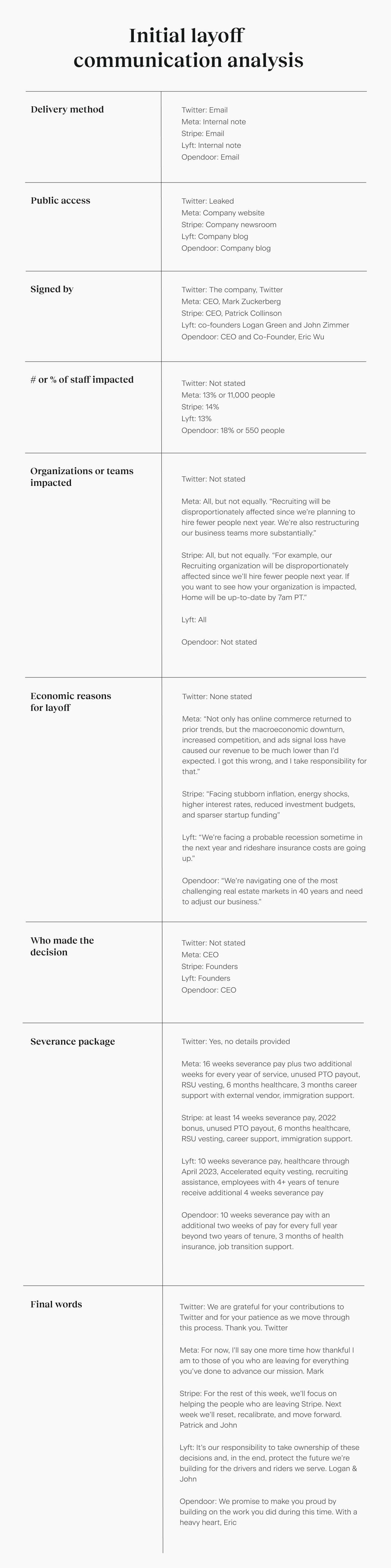
Below is our comparison of each of the company's initial layoff communications. All communications, except for Twitter, come from a CEO or founder, state the percentage of employees affected, share the economic reasons for the layoffs, and details of a severance package.
The New York Times interviewed Sandra Sucher, a professor of management at Harvard University who has studied layoffs for more than a decade, who said Twitter’s layoffs were some of the most poorly handled.
The New York Times explains, “While the scale was not unprecedented, it was unusual to see layoffs done so quickly without a detailed explanation provided to workers about who was being laid off and why, she said. ‘This is a master class in how not to do it,’ Ms. Sucher said. ‘If you were going to rank order ways to upset people, telling them you’re going to do it in advance, without rationale, that is a particularly inhumane way to treat them.’”
What the comparison shows is the stark difference between treating people humanely and treating people with little regard. By covering the six components outlined above - from taking accountability to providing a time for discussion and expressing value for departing employees - it is possible to communicate about a layoff with empathy.
Read all five layoff communications in full

Meta
Today I’m sharing some of the most difficult changes we’ve made in Meta’s history. I’ve decided to reduce the size of our team by about 13% and let more than 11,000 of our talented employees go. We are also taking a number of additional steps to become a leaner and more efficient company by cutting discretionary spending and extending our hiring freeze through Q1.
I want to take accountability for these decisions and for how we got here. I know this is tough for everyone, and I’m especially sorry to those impacted.
How did we get here?
At the start of Covid, the world rapidly moved online and the surge of e-commerce led to outsized revenue growth. Many people predicted this would be a permanent acceleration that would continue even after the pandemic ended. I did too, so I made the decision to significantly increase our investments. Unfortunately, this did not play out the way I expected. Not only has online commerce returned to prior trends, but the macroeconomic downturn, increased competition, and ads signal loss have caused our revenue to be much lower than I’d expected. I got this wrong, and I take responsibility for that.
In this new environment, we need to become more capital efficient. We’ve shifted more of our resources onto a smaller number of high priority growth areas — like our AI discovery engine, our ads and business platforms, and our long-term vision for the metaverse. We’ve cut costs across our business, including scaling back budgets, reducing perks, and shrinking our real estate footprint. We’re restructuring teams to increase our efficiency. But these measures alone won’t bring our expenses in line with our revenue growth, so I’ve also made the hard decision to let people go.
How will this work?
There is no good way to do a layoff, but we hope to get all the relevant information to you as quickly as possible and then do whatever we can to support you through this.
Everyone will get an email soon letting you know what this layoff means for you. After that, every affected employee will have the opportunity to speak with someone to get their questions answered and join information sessions.
Some of the details in the US include:
Severance. We will pay 16 weeks of base pay plus two additional weeks for every year of service, with no cap.
PTO. We’ll pay for all remaining PTO time.
RSU vesting. Everyone impacted will receive their November 15, 2022 vesting.
Health insurance. We’ll cover the cost of healthcare for people and their families for six months.
Career services. We’ll provide three months of career support with an external vendor, including early access to unpublished job leads.
Immigration support. I know this is especially difficult if you’re here on a visa. There’s a notice period before termination and some visa grace periods, which means everyone will have time to make plans and work through their immigration status. We have dedicated immigration specialists to help guide you based on what you and your family need.
Outside the US, support will be similar, and we’ll follow up soon with separate processes that take into account local employment laws.
We made the decision to remove access to most Meta systems for people leaving today given the amount of access to sensitive information. But we’re keeping email addresses active throughout the day so everyone can say farewell.
While we’re making reductions in every organization across both Family of Apps and Reality Labs, some teams will be affected more than others. Recruiting will be disproportionately affected since we’re planning to hire fewer people next year. We’re also restructuring our business teams more substantially. This is not a reflection of the great work these groups have done, but what we need going forward. The leaders of each group will schedule time to discuss what this means for your team over the next couple of days.
The teammates who will be leaving us are talented and passionate, and have made an important impact on our company and community. Each of you have helped make Meta a success, and I’m grateful for it. I’m sure you’ll go on to do great work at other places.
What other changes are we making?
I view layoffs as a last resort, so we decided to rein in other sources of cost before letting teammates go. Overall, this will add up to a meaningful cultural shift in how we operate. For example, as we shrink our real estate footprint, we’re transitioning to desk sharing for people who already spend most of their time outside the office.We’ll roll out more cost-cutting changes like this in the coming months.
We’re also extending our hiring freeze through Q1 with a small number of exceptions. I’m going to watch our business performance, operational efficiency, and other macroeconomic factors to determine whether and how much we should resume hiring at that point. This will give us the ability to control our cost structure in the event of a continued economic downturn. It will also put us on a path to achieve a more efficient cost structure than we outlined to investors recently.
I’m currently in the middle of a thorough review of our infrastructure spending. As we build our AI infrastructure, we’re focused on becoming even more efficient with our capacity. Our infrastructure will continue to be an important advantage for Meta, and I believe we can achieve this while spending less.
Fundamentally, we’re making all these changes for two reasons: our revenue outlook is lower than we expected at the beginning of this year, and we want to make sure we’re operating efficiently across both Family of Apps and Reality Labs.
How do we move forward?
This is a sad moment, and there’s no way around that. To those who are leaving, I want to thank you again for everything you’ve put into this place. We would not be where we are today without your hard work, and I’m grateful for your contributions.
To those who are staying, I know this is a difficult time for you too. Not only are we saying goodbye to people we’ve worked closely with, but many of you also feel uncertainty about the future. I want you to know that we’re making these decisions to make sure our future is strong.
I believe we are deeply underestimated as a company today. Billions of people use our services to connect, and our communities keep growing.Our core business is among the most profitable ever built with huge potential ahead. And we’re leading in developing the technology to define the future of social connection and the next computing platform. We do historically important work. I’m confident that if we work efficiently, we’ll come out of this downturn stronger and more resilient than ever.
We’ll share more on how we’ll operate as a streamlined organization to achieve our priorities in the weeks ahead. For now, I’ll say one more time how thankful I am to those of you who are leaving for everything you’ve done to advance our mission.
Mark
Stripe
View on Stripe's Company Newsroom
Today we’re announcing the hardest change we have had to make at Stripe to date. We’re reducing the size of our team by around 14% and saying goodbye to many talented Stripes in the process. If you are among those impacted, you will receive a notification email within the next 15 minutes. For those of you leaving: we’re very sorry to be taking this step and John and I are fully responsible for the decisions leading up to it.
We’ll set out more detail later in this email. But first, we want to share some broader context.
The world around us
At the outset of the pandemic in 2020, the world rotated overnight towards e-commerce. We witnessed significantly higher growth rates over the course of 2020 and 2021 compared to what we had seen previously. As an organization, we transitioned into a new operating mode and both our revenue and payment volume have since grown more than 3x.
The world is now shifting again. We are facing stubborn inflation, energy shocks, higher interest rates, reduced investment budgets, and sparser startup funding. (Tech company earnings last week provided lots of examples of changing circumstances.) On Tuesday, a former Treasury Secretary said that the US faces “as complex a set of macroeconomic challenges as at any time in 75 years”, and many parts of the developed world appear to be headed for recession. We think that 2022 represents the beginning of a different economic climate.
Our business is fundamentally well-positioned to weather harsh circumstances. We provide an important foundation to our customers and Stripe is not a discretionary service that customers turn off if budget is squeezed. However, we do need to match the pace of our investments with the realities around us. Doing right by our users and our shareholders (including you) means embracing reality as it is.
Today, that means building differently for leaner times. We have always taken pride in being a capital efficient business and we think this attribute is important to preserve. To adapt ourselves appropriately for the world we’re headed into, we need to reduce our costs.
How we’re handling departures
Around 14% of people at Stripe will be leaving the company. We, the founders, made this decision. We overhired for the world we’re in (more on that below), and it pains us to be unable to deliver the experience that we hoped that those impacted would have at Stripe.
There’s no good way to do a layoff, but we’re going to do our best to treat everyone leaving as respectfully as possible and to do whatever we can to help.
Some of the core details include:
Severance pay. We will pay 14 weeks of severance for all departing employees, and more for those with longer tenure. That is, those departing will be paid until at least February 21st 2023.
Bonus. We will pay our 2022 annual bonus for all departing employees, regardless of their departure date. (It will be prorated for people hired in 2022.)
PTO. We’ll pay for all unused PTO time (including in regions where that’s not legally required).
Healthcare. We’ll pay the cash equivalent of 6 months of existing healthcare premiums or healthcare continuation.
RSU vesting. We’ll accelerate everyone who has already reached their one-year vesting cliff to the February 2023 vesting date (or longer, depending on departure date). For those who haven’t reached their vesting cliffs, we'll waive the cliff.
Career support. We’ll cover career support, and do our best to connect departing employees with other companies. We’re also creating a new tier of extra large Stripe discounts for anyone who decides to start a new business now or in the future.
Immigration support. We know that this situation is particularly tough if you’re a visa holder. We have extensive dedicated support lined up for those of you here on visas (you’ll receive an email setting up a consultation within a few hours), and we’ll be supporting transitions to non-employment visas wherever we can.
Most importantly, while this is definitely not the separation we would have wanted or imagined when we were making hiring decisions, we want everyone that is leaving to know that we care about you as former colleagues and appreciate everything you’ve done for Stripe. In our minds, you are valued alumni. (In service of that, we’re creating alumni.stripe.com email addresses for everyone departing, and we’re going to roll this out to all former employees in the months ahead.)
We are going to set up a live, 1-1 conversation between each departing employee and a Stripe manager over the course of the next day. If you are in an impacted group, look out for a calendar invitation.
For those not affected, there’ll be some bumpiness over the next few days as we navigate a lot of change at once. We ask that you help us do right by Stripe’s users and the departing Stripes.
Our message to other employers is that there are many truly terrific colleagues departing who can and will do great things elsewhere. Talented people come to Stripe because they’re attracted to hard infrastructure problems and complex challenges. Today doesn’t change that, and they would be fantastic additions at almost any other company.
Going forward
In making these changes, you might reasonably wonder whether Stripe’s leadership made some errors of judgment. We’d go further than that. In our view, we made two very consequential mistakes, and we want to highlight them here since they’re important:
We were much too optimistic about the internet economy’s near-term growth in 2022 and 2023 and underestimated both the likelihood and impact of a broader slowdown.
We grew operating costs too quickly. Buoyed by the success we’re seeing in some of our new product areas, we allowed coordination costs to grow and operational inefficiencies to seep in.
We are going to correct these mistakes. So, in addition to the headcount changes described above (which will return us to our February headcount of almost 7,000 people), we are firmly reining in all other sources of cost. The world is hard to predict right now, but we expect that these changes will set us up for robust cash flow generation in the quarters ahead.
We are not applying these headcount changes evenly across the organization. For example, our Recruiting organization will be disproportionately affected since we’ll hire fewer people next year. If you want to see how your organization is impacted, Home will be up-to-date by 7am PT.
We’ll describe what this means for our company strategy soon. Nothing in it is going to radically change, but we’re going to make some important edits that make sense for the world that we’re headed into, and tighten up our prioritization substantially. Expect to hear more on this over the next week.
While the changes today are painful, we feel very good about the prospects for innovative businesses and about Stripe’s position in the internet economy. The data we see is consistent with this encouraging picture: we signed a remarkable 75% more new customers in Q3 2022 than Q3 2021, our competitive win rates are getting even better, our growth rates remain very strong, and on Tuesday we set a new record for total daily transaction volume processed. Our smaller users (many of whom are just “big customers that aren’t yet big”) are, in aggregate, growing extremely quickly, showing that plenty of technology S curves remain in the early innings and that our customers remain impressively resilient in the face of the broader global challenges.
People join Stripe because they want to grow the internet economy and boost entrepreneurship around the world. Times of economic stress make it even more important that we find innovative ways to help our users grow and adapt their businesses. Today is a sad day for everyone as we say goodbye to a number of talented colleagues. But we’re ready for a pitched effort ahead, and we’re putting Stripe on the right footing to face it.
For the rest of this week, we’ll focus on helping the people who are leaving Stripe. Next week we’ll reset, recalibrate, and move forward.
Twitter
Team,
In an effort to place Twitter on a healthy path, we will go through the difficult process of reducing our global workforce on Friday. We recognize that this will impact a number of individuals who have made valuable contributions to Twitter, but this action is unfortunately necessary to ensure the company’s success moving forward.
Given the nature of our distributed workforce and our desire to inform impacted individuals as quickly as possible, communications for this process will take place via email. By 9AM PST on Friday Nov. 4th, everyone will receive an individual email with the subject line: Your Role at Twitter. Please check your email, including your spam folder.
If your employment is not impacted, you will receive a notification via your Twitter email.
If your employment is impacted, you will receive a notification with next steps via your personal email.
If you do not receive an email from twitter-hr@ by 5PM PST on Friday Nov. 4th, please email peoplequestions@twitter.com.
To help ensure the safety of each employee as well as Twitter systems and customer data, our offices will be temporarily closed and all badge access will be suspended. If you are in an office or on your way to an office, please return home.
We acknowledge this is an incredibly challenging experience to go through, whether or not you are impacted. Thank you for continuing to adhere to Twitter policies that prohibit you from discussing confidential company information on social media, with the press or elsewhere.
We are grateful for your contributions to Twitter and for your patience as we move through this process.
Thank you.
Twitter
Opendoor
Team,
I mentioned that the best leaders lead with their head and their heart. It’s with a heavy heart that I share this news today. For those who missed the Open House, we’ve made the difficult decision to reduce our team by ~550 people across all functions – approximately 18% of the company.
The reality is, we’re navigating one of the most challenging real estate markets in 40 years and need to adjust our business. To manage through the turbulence in the market, we’ve worked quickly over the last two quarters to reduce our operating expenses. Prior to today, we scaled back our capacity by over 830 positions – primarily by reducing third party resourcing – and we eliminated millions of fixed expenses. We did not make the decision to downsize the team today lightly but did so to ensure we can accomplish our mission for years to come. And while we may be navigating a once-in-forty year market transition, it doesn’t take away the difficulty, frustration, and sadness downsizing brings. We’ve built a culture and community of #oneteamonedream and worked tirelessly together to serve our customers. This is what makes our decision even more difficult.
When we embarked on this journey nine years ago, almost every investor I spoke with was shocked by the ambition and boldness of our mission – and that instead of an incremental approach, we were willing to do what is best and right for customers to change the entire system end-to-end. Doing something important is going to have its setbacks and ups and downs, but through this journey, we have done just that – we’ve begun the change the system needs. And, even in a moment like today, I can say that your impact has been the catalyst for change and that your work has enabledJulie Damavandi,Robin Race,Julie & Bela, and 200,000 other customers to make life-changing moves.
For those impacted, please know we’re doing everything we can to be fair and generous:
Severance pay:Everyone leaving will receive ten weeks of pay, with an additional two weeks of pay for every full year beyond two years of tenure.
Health care coverage:All current healthcare benefits will remain active for the rest of the month, then we will pay for three months of health insurance.
Job transition support:We will also offer job transition support and launch an opt-in talent directory to help departing team members connect with new opportunities.
We want to provide clarity on next steps as quickly as possible. We’ll be sending an email to everyone at Opendoor within the next hour, which will let you know whether your role has been impacted or not. For those who will be leaving us today, you will also receive a calendar invite to meet with a leader to discuss this change, learn about your separation package, and ask questions.
I understand the burden and responsibility you all have placed on my shoulders, especially to those we are saying ‘goodbye for now’ to. And, that burden weighs heavy as we now have the task to ensure your hard work carries forward and we accomplish our mission. Thank you for showing up every day for our mission, to help our customers, and to change an antiquated industry. I’m grateful that you have helped build and shape Opendoor to where it is today. We promise to make you proud by building on the work you did during this time.
With a heavy heart,
Eric
Lyft
Team,
We just sent an invitation for everyone to join us for an all-hands at 11:00 am PT to share some tough news. Despite efforts to avoid this day, we’ve made the difficult decision to lay off 13% of the team. Additionally, we are pursuing a divestiture (sale) of our first-party vehicle service business, and in that case we do expect most of those team members will be offered roles from the acquiring company.
We know today will be hard. To help provide initial context, we want to share how we made this decision, how we’re supporting departing team members, and what to expect over the coming days.
What’s happening
There are several challenges playing out across the economy. We’re facing a probable recession sometime in the next year and rideshare insurance costs are going up. We worked hard to bring down costs this summer: we slowed, then froze hiring; cut spending; and paused less-critical initiatives. Still, Lyft has to become leaner, which requires us to part with incredible team members.
The layoffs impact every organization in the company, and were based on deprioritized initiatives, an effort to reduce management layers, broader savings goals, and, in some cases, performance trajectory.
We are confident in the overall trajectory of the business. It was important to take these proactive actions to ensure we can accelerate execution, stay focused on the best opportunities to drive profitable growth, and deliver strong business results in 2023 and beyond.
Support for departing team members
We understand the real impact this decision has on departing team members. Lyft will offer support to departing team members:
10 weeks of pay.
Healthcare coverage through April 30, 2023, including access to Modern Health.
Accelerated equity vesting for the November 20 vesting date.
Recruiting assistance, including coaching sessions on resumes and interviews.
Team members with 4+ years with Lyft will receive an additional four weeks of pay.
Moving forward
Our priority today is taking care of departing team members, who for many of us are also friends. To those team members, although we know no words are sufficient, thank you for everything you have done for the Lyft community, mission, and business.
We are not immune to the realities of inflation and a slowing economy. We need 2023 to be a period where we can better execute without having to change plans in response to external events — and the tough reality is that today’s actions set us up to do that. It’s our responsibility to take ownership of these decisions and, in the end, protect the future we’re building for the drivers and riders we serve.
Logan & John
Post-layoff all-company meeting talking points
Below is an excerpt from our guide, How to prepare for and communicate layoffs which provides support for CEOs, Founders, and People Teams who are in the layoff planning process. We also have a layoff communication checklist that you can use to plan and keep track of layoff tasks and communications.
These post-layoff all-company meeting talking points are very similar to the points that should be covered in initial layoff communications. It is important to follow up written communications with an in-person or virtual meeting where you can engage with remaining employees and begin to build back trust.
First, take accountability
Admit what went wrong. Messaging should be owned by the CEO. This is where trust and confidence is built or broken.
Provide transparency
Communicate the process the organization underwent in deciding to implement the layoff and the process used to decide which jobs would be eliminated. Transparency is essential.
Employees are triggered by a sense of fairness. Explaining the procedures followed will help reduce those triggers and can also minimize the likelihood of potential legal issues.
Share the plan forward
Outline and reiterate the plan forward including the new organizational structure. This shows the conviction that the layoff was not for nothing and is meant to reassure those who’ve believed in and have worked hard for the company’s vision.
Provide assurance
If possible, assure that all measures have been taken to ensure this happens once and without more rounds of layoffs in the near future. You don’t want your people to have a lingering fear that more people are going to be laid off.
Allow for questions
Then, allow employees to speak either in a Q&A as a company or in small groups with the management team. Allow employees to express how they feel about the situation.
Good communication starts with empathy
Layoffs are emotional and stressful, and while good communication can’t remove that burden, poor communication can make it worse. Good communication starts with empathy - understanding the emotional state of the recipient and taking that into account. The more you can address the questions people will have when faced with a layoff, the better they can begin to process what has happened.
Here are just a few ways your company can support employees who have been laid off:
- Severance pay
- Healthcare
- Early stock option vesting
- Unused PTO payout
- Recruiting assistance for a new job
- Immigration support
In addition to crafting initial layoff communications with dignity, remember to follow up with employees post-departure to re-offer the support services you’ve chosen to provide.